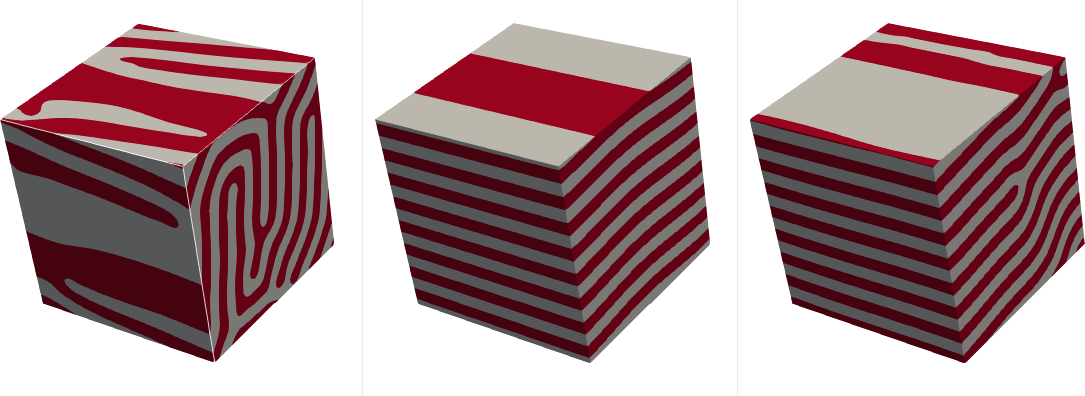
Lamellar phase(bilayer of oil,water and surfactants) is commonly used in F.M.C.G industries and in food product industries such as butter substitutes.Still today the high stiffness of lamellar phase is mystery as a proper framework linking its constituent material property to mesocopic structures to macroscopic properties such as viscosity is missing.. There is lack of continuum constitutive model of this highly anisotropic material in practical purpose and doing microscopic M.D simulations to capture properties at level of hundreds of layer is still infeasible. So, we propose mesoscopic coarse grained model of hydrophilic and hydrophobic phase to relate structure and rheology two way coupling of lamellar phase 3-D and 2-D.This concentration dependant ‘elastic stress’ model captures the high excess viscosity of lamellar phase corresponding to its non equilibrium defect structures. This actually eliminates microscopic details coming from sub layer length scale combining them in to some dimensionless parameters signifying ration different timescales and stresses.So, we can predict the structure and excess viscosity evolution of lamellar phase with respect to those parameters which tells the way to tailor or select material to get special rheological functionality.The total frame work incorporates hierarchical simulations from low to high length scales but i focus on mesocospic simulations assuming parameters in certain characteristics regimes. The conservation equations are solved by Lattice Boltzmann simulation. 3-D: We have seen different patterns of concentration evolving as we move to low to High Er(viscous stress/elastic stress) . The magnitude of excess viscosity and long time defect density (disorder in the system) vary a lot from low to high Er. In moderate Er Effect of Sc is huge in terms of transient viscosity , alignment time and log time disorder in the sample.We see hexagonal meta-stable structure at high Er(low bending modulus) with a low excess viscosity.The fate is also very different when we introduce contrast in oil and water.Samples ordering earlier does not even order after introducing contrast. The main feature of 3-D defects in flow plane only contributes to viscosity. 2-D:In 2-D, edge defect pinning in samples lead very high excess viscosity and almost plug like velocity in pinned portion.We study how these edge defect interacts with each other in different Er , Sc regime , direction of shear, system sizes.Two different additional defect creation mechanism and their criteria predicted from theory is qualitatively found same with simulations. Moreover mobility of these defects and macroscopic configuration elasticity is also calculated in 2-D.